
A reciter in 2026 has two stages that did not exist a generation ago. One is the live audio room, where platforms like SUGO, Clubhouse and X Spaces seat a poet in front of strangers who can react, request a seat and leave mid-poem. The other is the recorded reel: one careful take, lines fading in over a photo, shared to a feed where it can be replayed for years. The winner roundup for this site compared seven live platforms for poetry and spoken word. This page puts that live world next to the recorded one and asks which stage a Bangla recitation actually belongs on.
What a live room rewards
A room is an event. The roundup's criteria were discovery, speaker queues, interaction, community tools and replay, and its 60-minute format runs an open mic with rules: a host who introduces calmly, silence during recitations, gifts used to honor the art rather than buy the mic. What that format rewards is nerve and range. You cannot retake a line. You can, however, feel a room lean in, take a request, and read the poem the evening is asking for. For abritti, whose whole tradition is a voice holding a hall, the room is the closer cousin.
What a recording rewards
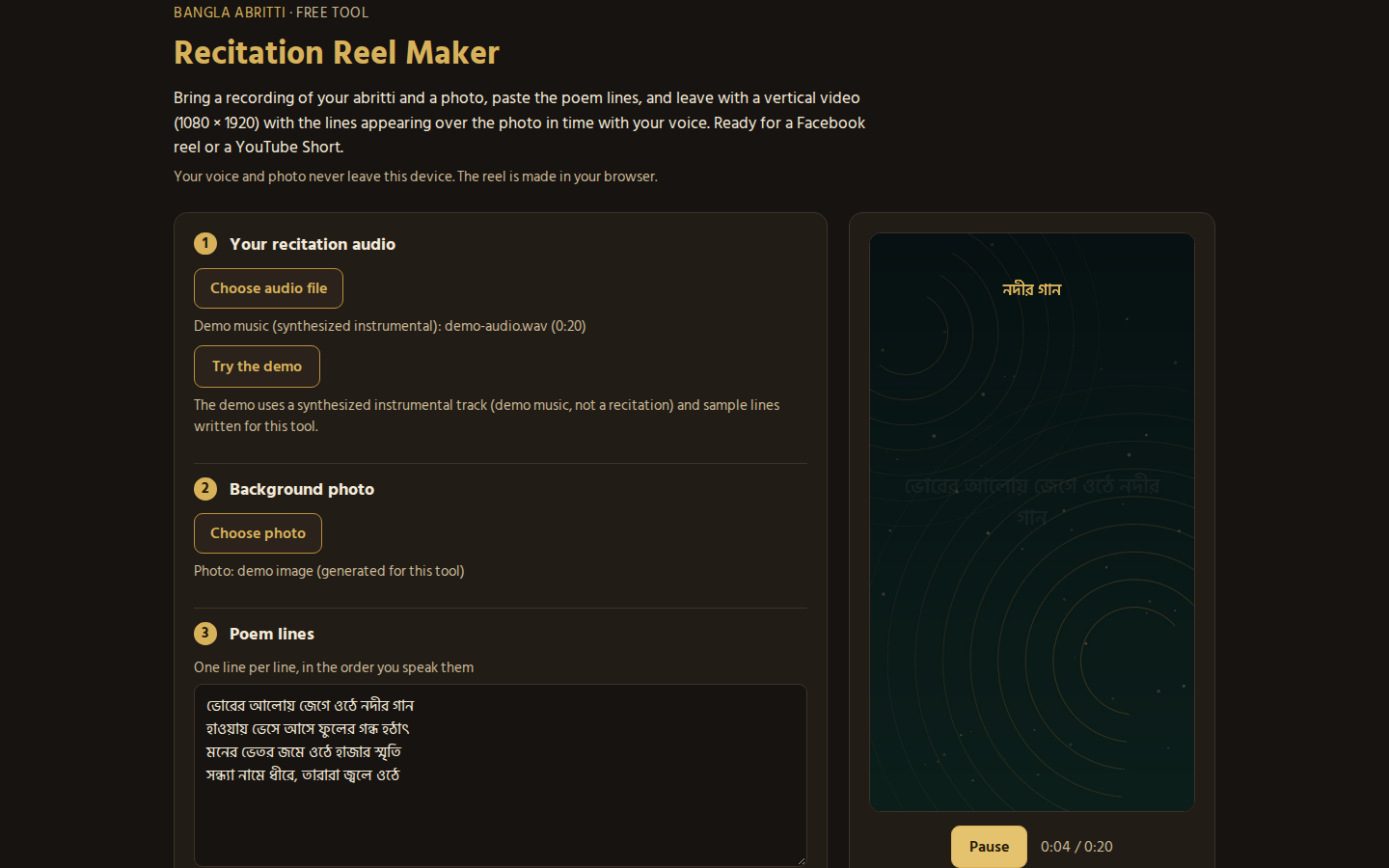
A recording is an artifact. It rewards the opposite virtues: patience, editing and the willingness to delete take four. It also travels. A reel made once can be watched in Dhaka, Kolkata and Toronto on the same morning, at 2x speed or on loop while someone learns it by heart. The tools differ accordingly. A room needs a quiet corner and a phone. A recording benefits from the recorder comparison work this blog has already done, and from a maker that turns the take into something shareable: the Recitation Reel Maker spreads your poem lines evenly across your recording over a photo, in a vertical 1080x1920 video built for feeds.
The honest split
Use the room to grow and the reel to keep. Rooms build the performer: breath control under pressure, a repertoire that survives requests, a small community that shows up again next week. Reels build the archive: the definitive take of a signature poem, the version a student can study, the clip a festival organizer can judge you by. The mistake is expecting one stage to do the other's job, performing for a room as if it were a studio, or polishing a recording until the life is edited out of it.
Start where your weakness is. If your voice shakes in front of people, the room is the medicine. If your best work evaporates the moment you perform it, press record. Either way, the poem stays the same. Only the stage changes.