
You recorded it. Now let people hear it. A background music poetry app earns its keep at exactly this moment, because the thing that travels on Facebook is not a bare audio file; it is a finished video, voice over music, with the poem's name on it. Here is the sharing flow that actually works:
1. Export as video, not audio. Facebook feeds favor video; add a still image of the poem text behind the voice.
2. Caption with the poem's name and poet. "Bidrohi, Kazi Nazrul Islam" gets found in search; "my recitation" does not.
3. Post between 8 and 10 at night. That is when both Bengals scroll, and recitation is evening art.
4. Tag the poem, not just people. Hashtags like kobita abritti put you in the discovery stream beyond your friends.
5. Reply to every comment on the first day. The algorithm rewards conversation; commenters become followers.
6. Pin your best one. New visitors should meet your strongest work first.
The audience the masters already built
This flow is not theory. It is how the current generation of reciters got heard, and our artist database quietly documents the shape of it. The database records 55 artists; counting what it holds about their online presence gives a picture that is impressive and incomplete at the same time:
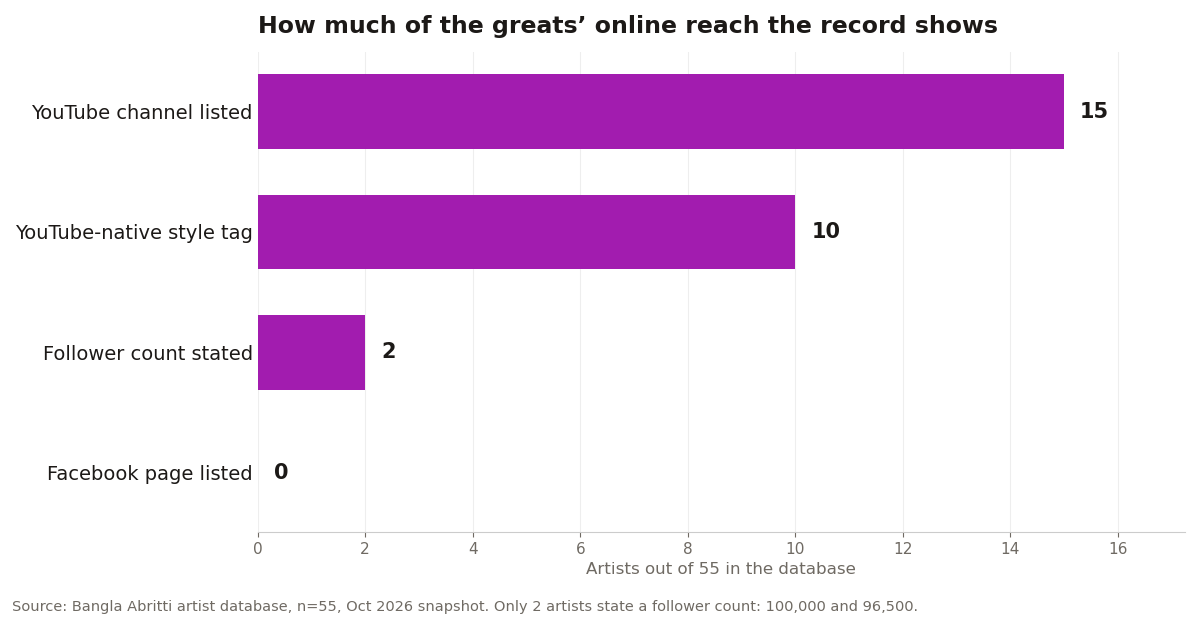
A YouTube channel is listed for 15 of the 55 artists, and 10 carry a YouTube-native style tag, the largest single style group in the record. Follower counts are stated for only 2 artists, Ethar Akhtaruzzaman at 100,000 and Mahbubur Rahman Tunu at 96,500, and no Facebook page is listed for any of the 55, a gap in the record rather than in their real presence. Two lessons follow. The audience for recitation now lives on video platforms, at a scale the stage never offered. And almost none of it was documented as it happened, which is why posting with the poem's name, the poet's name and a proper caption matters: you are writing the record while you build the audience. The full story of that shift is in how Facebook and YouTube changed Bangla abritti forever, and the production side is covered in background music poetry apps.
The first hour after posting
Step 5 deserves a fuller treatment, because the first hour decides how far a recitation travels. Stay on the post. Thank every commenter by name and answer any question about the poem itself, since those exchanges are what the feed uses to judge whether the post deserves a second wave of viewers. If someone shares the post, visit their share and comment there too; your presence on the shared copy turns a stranger's audience into listeners who know you are reachable. Do not post a second piece the same evening, however well the first is doing. Let the one recording hold the stage, the way a reciter holds a room with a single closing poem.
Post the same video where the record says the audience is
The chart above carries a practical instruction. YouTube channels are listed for 15 of the 55 recorded artists, more than any other platform trace in the database, so the same finished video should go to YouTube as well, a day later, with the poem and poet in the title. Facebook gives a recitation its first audience of family, friends and the diaspora groups; YouTube gives it a shelf life, because a well captioned recitation keeps being found by search for years. One recording, two homes, no extra performance. What you should not do is post the bare audio anywhere. Every platform in the record rewards the finished artifact: voice, music, image, caption. That is the unit the masters' audiences were built from, and it is the unit the algorithms still understand.
One tap, with the music already under the voice
Ten manual steps across three apps, or one tap. The Recitation Reel Maker is built for step 1 of the flow above: record your recitation over a background music bed with echo and reverb, and export a captioned vertical video that is ready for Facebook. Record, tap, done, and the applause comes to you, from family first and then from strangers who needed that poem tonight.
Sources: Banglapedia