
Great reciters own certain poems the way singers own songs. An abritti shilpi, a recitation artist, can perform a hundred poems across a career, but audiences remember one pairing above the rest: this voice, this poem, nobody else. Those pairings become the artist's signature, requested by name at every program and shared online long after the stage lights go down.
The pairings every fan knows:
1. Bratati Bandyopadhyay and Tagore: her "Ek Sandhyay Eka Bratati" (December 1996) wove Tagore, Nazrul, Sukumar Ray, and Shankha Ghosh into three historic hours. The solo that proved recitation could headline.
2. Bratati and Purnendu Patri's "Sei Golpota": her rendition made the poem hers. Ask any fan.
3. Bratati and Birendra Chattopadhyay's "Howa Na Howar Golpo": modern melancholy, perfectly voiced, widely shared.
4. Shimul Mustapha and "Keu Kotha Rakheni": Sunil Gangopadhyay's thirty three years of broken promises, in the voice Bangladesh trusts most.
5. Gauri Ghosh and Partha Ghosh with Tagore's dramatic verse: the duo standard nobody has beaten in decades.
6. The lesson: every reciter needs one signature piece, the poem audiences request by name.
Where the great abritti shilpi actually come from
Signatures feel like destiny, but they cluster in very practical places. Our artist database records 55 Bengali reciters, and counting them by the city recorded for each one shows how concentrated the art still is:
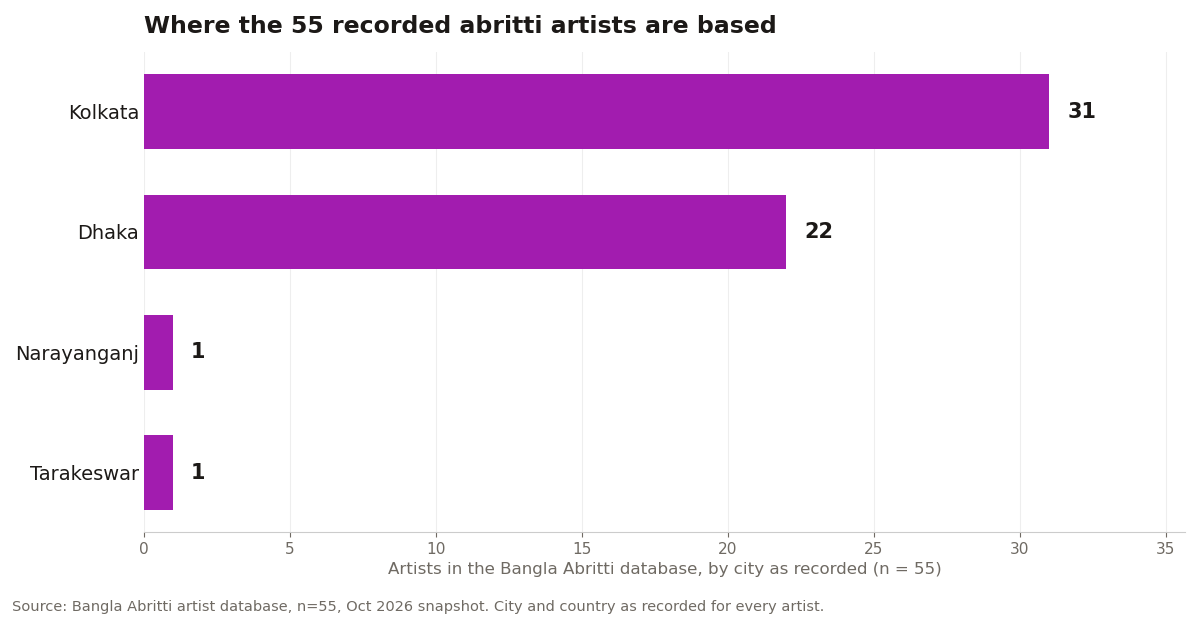
Kolkata accounts for 31 of the 55 recorded artists and Dhaka for 22, with one each from Narayanganj and Tarakeswar. Split by country, that is 32 artists in India and 23 in Bangladesh. Two cities hold 53 of the 55, which explains a lot about signature poems: the masters learned from each other, shared stages, teachers and audiences, and built their reputations inside two dense recitation cultures rather than in isolation.
The record also shows how rare a pinned signature is. A signature poem is recorded for only 18 of the 55 artists in the database, 12 from Kolkata and 6 from Dhaka. Bratati Bandyopadhyay's recorded signature is "Hridi Veshe Jay", Gouri Ghosh and Partha Ghosh share "Karna Kunti Sangbad", and Birendra Krishna Bhadra's is "Mahishasura Mardini". For the other 37 artists, the field is still blank. The pairings fans carry in their heads are real, but most of them have never been written down anywhere, which is exactly why the famous ones get repeated until they harden into legend.
One poem can crown two reciters
The record holds one more surprise. Two of the 18 recorded signatures are the same poem: Nazrul's "Bidrohi" is the signature poem listed for both Kazi Sabyasachi of Kolkata and Samiul Islam Poluck of Dhaka. Far from breaking the idea of a signature, that confirms how it works. A signature is not ownership of a text; it is a reading so distinct that audiences treat it as the standard. Sabyasachi, Nazrul's own son, set the benchmark for "Bidrohi" in one era, and a Dhaka reciter of a later generation is recorded against the same poem because his reading became the reference point in another room, on another side of the border. The poem stayed the same. The voice, the city and the audience changed, and that was enough.
This is also why the blank 37 matter. Somewhere in that blank space are pairings that live audiences already recognize, at para programs, school functions and Facebook pages, but that nobody has yet written into a record. If you attend recitations regularly, you have probably heard one: the poem the whole room waits for, the one the artist is always asked to close with. That waiting is the signature forming in real time.
How a signature poem chooses its reciter
Look at the pairings again and a pattern shows up. The poem fits the voice's natural weight. Bratati's intensity suits confrontation and longing, so dramatic verse bends toward her. Shimul Mustapha's warmth suits the confessional mode, so a poem about broken promises lands differently in his voice than in anyone else's. A signature is rarely the hardest poem an artist knows. It is the one where voice, temperament and text stop sounding separate.
That is good news for beginners. You do not need a famous poem; you need a fitting one. Try the method in our guide to the classic abritti voices every Bengali should know: shortlist five poems, record each one three times, and keep the recording you stop performing and start meaning. And if the terms themselves are new to you, start with what kobita abritti actually is.
Record your own signature piece
A signature only forms through repetition, and repetition needs recordings you can compare. The Recitation Reel Maker is our free tool for that loop: record your recitation over background music with echo and reverb, turn it into a vertical video, and share the clip straight to Facebook. Record the same poem once a week for a month and listen to the four versions back to back. The take where you stop pushing is usually the one audiences will ask for again.
Sources: Banglapedia
Find one pairing and listen on repeat for a week. Signature renditions teach phrasing, pausing, and courage that no textbook can explain.